When NVLink Actually Helps: llama.cpp vs vLLM on Dual RTX 3090
Two RTX 3090s can share a model two ways. One keeps the cards nearly silent with each other. The other makes them talk on every single layer. That difference — not the silicon — decides whether your NVLink bridge is worth anything.
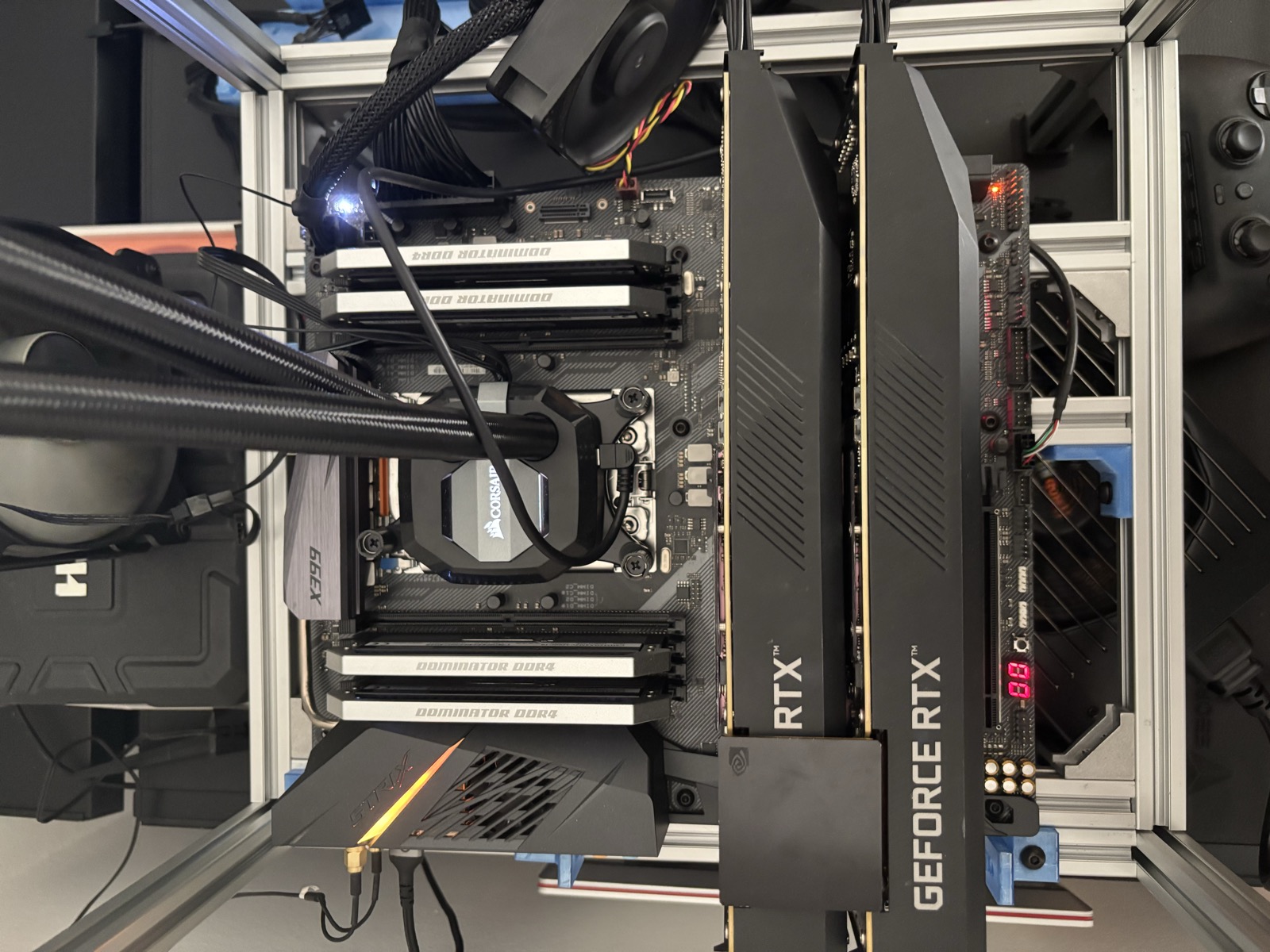
Two ways to split a model#
When a model spans two GPUs, the split strategy sets how much they communicate:
- Layer split — GPU 0 holds the first half of the layers, GPU 1 the second. They exchange one set of activations at the handoff: a few MB per token. The bridge is mostly idle.
- Tensor parallelism (TP) — every layer is cut across both cards. Each computes a slice, then they all-reduce to merge the result — every layer, every token. That is the heavy, constant cross-GPU traffic NVLink exists for.
Same model, same cards. The communication bill differs by orders of magnitude.
llama.cpp — quiet, single-stream#
llama.cpp defaults to layer split. llama-bench, Qwen3.6-27B 4-bit, 512-token prompt → 128-token generation:
Config               pp512 (t/s)   tg128 (t/s)
──────────────────────────────────────────────
1× RTX 3090             1182          31.0
2× RTX 3090 (layer)     1171          39.0
2× RTX 3090 (row / TP)   263          23.9
Layer split adds ~26% generation over a single card — pure memory bandwidth, almost no chatter on the bridge. Force tensor split (“row”) and it collapses to 24 t/s: llama.cpp pays the per-layer sync without a path built to absorb it. The all-reduce is only free when both the engine and the link are ready for it.
vLLM — loud, batched#
vLLM does TP properly, plus continuous batching. TP=2, same model, same 512→128:
Workload (TP=2)                Result
────────────────────────────────────────
Single request (512→128)       2.2 s
200 concurrent requests        ~135 s
Peak generation                ~760 tok/s
One request, it already edges llama.cpp — 2.2 s versus 3.7 s. Under load it is a different class: 200 requests in ~2 minutes against llama.cpp’s ~12, because every layer’s all-reduce rides the bridge instead of stalling the cards.
Where NVLink earns its keep#
This is the whole point. Layer split barely uses the interconnect, so NVLink does nothing for llama.cpp’s fast path — pull the bridge and the numbers wouldn’t move. Tensor parallelism hits it on every forward pass, and the 3090’s NVLink (~112 GB/s) carries that traffic while bypassing the PCIe peer-to-peer block NVIDIA ships on consumer cards. Without it, the all-reduce falls back to slow host-staged copies — the same kind of cliff the “row” split hits above.
NVLink is not a generic “make multi-GPU faster” upgrade. It is specific: it pays off the moment your engine runs per-layer all-reduce, and not a second before.
The call#
Match the bridge to the workload. Single-stream on llama.cpp never touches NVLink — save the slot. Tensor-parallel serving on vLLM lives on it. The cards were identical in every test; the only thing that changed was how much they had to talk between the layers.